1
See it
Meet the word, its meaning, its sound, and its first shape.
 Eesti keeles
Estly.ee helps learners remember Estonian words through recall, repetition, sound, spelling, and playful interaction.
"Hea sõna leiab hea paiga."
A good word finds a good place.
Estly.ee is a free, non-profit vocabulary learning platform for Estonian. It is developed primarily through the personal work of Joosep Wong, with infrastructure and operational support provided voluntarily by Next Apogee OÜ and Amekage OÜ. The platform is offered free of charge to learners of Estonian, and its core learning tools are intended to remain free.
There is no subscription. No premium dictionary hidden behind a paywall. No learner should be blocked from learning Estonian because they cannot pay for vocabulary tools.


Estonian is spoken by around one and a half million people. But numbers do not tell the whole story.
This is a language with fourteen cases, old songs, sharp poetry, stubborn grammar, and an even more stubborn history. It has survived occupations, empires, pressure, neglect, and the quiet assumption that small languages should eventually disappear.
It did not disappear.
Estly.ee exists because a language with this much endurance deserves learning tools with the same spirit.
For many non-native speakers, Estonian is not easy to enter. The first steps can feel slow. Words look unfamiliar. Endings change. Pronunciation needs attention.
A learner may understand a grammar rule, but still forget the word when it is needed. Estly.ee was built for that exact moment.
The goal is simple: to help learners find the word, understand the form, and remember it with less fear.
This is not only a dictionary. It is a learner-first vocabulary platform built around search, recall, repetition, sound, spelling, and playful interaction.
Traditional Estonian tools usually expect correct input. They assume you already know the dictionary form, the grammar case, and the correct spelling. For native speakers, that is normal. For foreigners, it can be a wall.
Estly.ee starts from the learner's real situation: you see a word in daily life, but you do not know where it comes from or how to search for it.
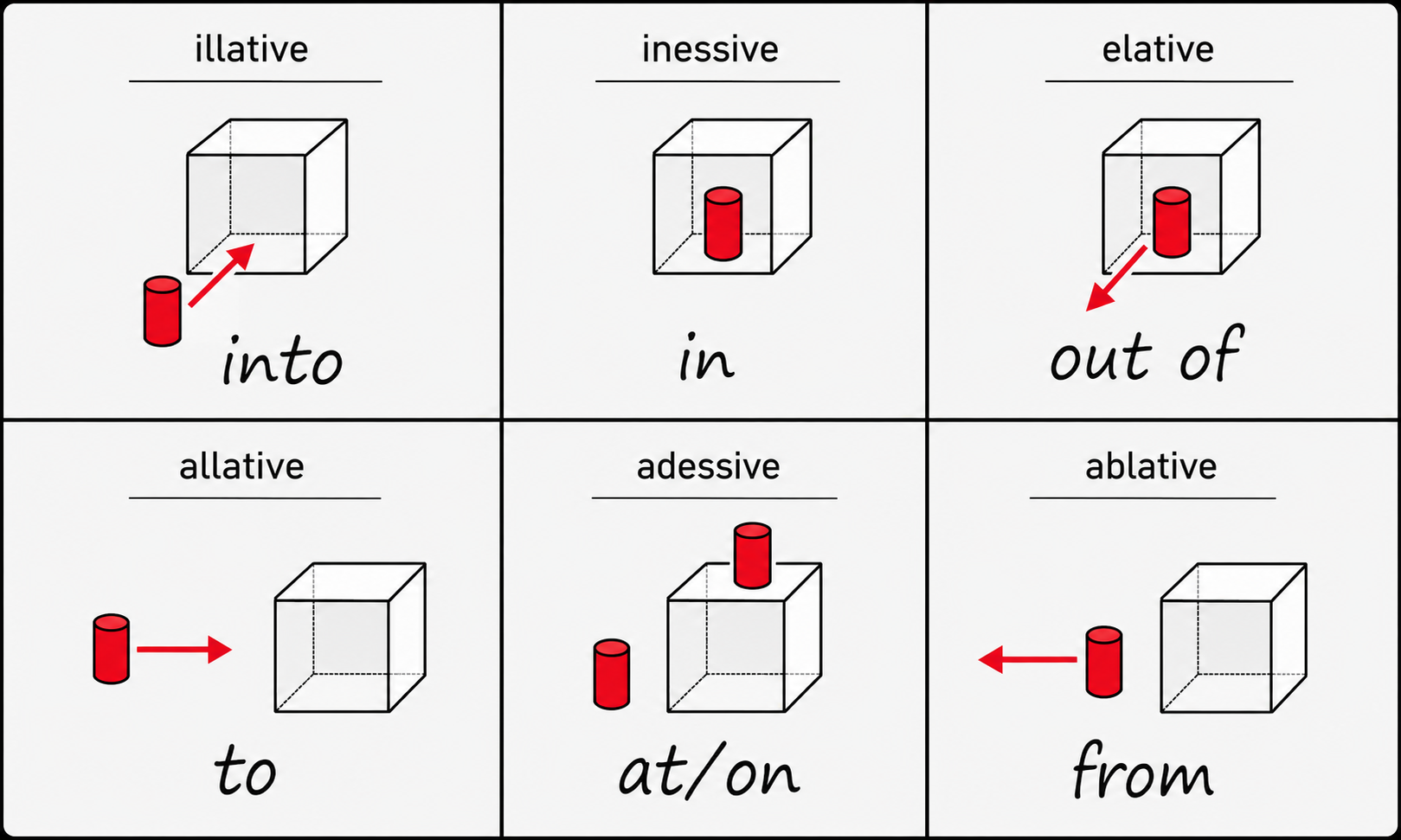
Estonian words change form constantly. For example, when Joosep Wong first heard "Häid jõule!", he did not know that häid comes from hea, or that it is the plural partitive form used in the greeting. A traditional dictionary may expect the learner to search for hea. But the learner only has häid. That is exactly the gap Estly.ee was built to solve. Whether the word appears in nominative, genitive, partitive, illative, inessive, elative, allative, adessive, ablative, translative, terminative, essive, abessive, or comitative, Estly.ee tries to guide the learner back to the word they need. Try the dictionary →
Many learners do not use an Estonian keyboard every day. They may not know how to type õ, ä, ö, ü, š, or ž quickly. They may use an English keyboard, a mobile phone, or only remember the sound of the word. You can search with missing special letters, imperfect spelling, or uncertain forms, and Estly.ee will still try to help you find the right word.
Foreigners do not usually meet Estonian only in clean textbook examples. They meet it in school emails, signs, rental contracts, doctor appointments, supermarket labels, government pages, job emails, children's homework, and casual greetings. Estly.ee is built for that real-life moment when the learner thinks: "What does this word mean here?"
Finding a word is useful. Remembering it is better. Estly.ee connects smart search with active practice: flashcards, multiple choice, fill in the blank, listening, spelling, typing, and games. Find the word. Understand the form. Practise it. Remember it.
Estly.ee was built first for foreigners learning Estonian. But because it connects Estonian with multiple languages, Estonian speakers can also use Estly.ee to learn other supported languages through Estonian. So Estly.ee is both a bridge into Estonian for foreigners, and a bridge from Estonian to the world for Estonian speakers.
Traditional tools often start from correct Estonian.
Estly.ee starts from learner confusion.
Estly.ee is built for people who learn Estonian from different language backgrounds. Many learners in Estonia do not start from English. Some speak Russian, Ukrainian, Chinese, Japanese, German, Finnish, or other languages at home. Some are expats, international students, new residents, employees, parents, or long-term immigrants trying to understand Estonian in daily life.
That is why Estly.ee is designed as a multilingual Estonian learning platform. You can use Estly.ee to learn Estonian from English, Russian, Chinese, Japanese, German, Finnish, and other supported languages.
For Russian-speaking learners, Estly.ee can be especially useful because many people in Estonia still use Russian in daily life but need Estonian for work, school, citizenship, residence permits, public services, and integration. Estly.ee helps Russian speakers search Estonian words, understand Estonian word forms, practise vocabulary, and build memory through games and active recall.
Whether you want to learn Estonian from Russian, learn Estonian from English, learn Estonian from Chinese, or use Estonian to learn other languages, Estly.ee gives you a practical bridge between languages.
It is not only an Estonian dictionary. It is a multilingual vocabulary tool for real learners living with real language problems.
Adults do not usually remember vocabulary by reading a list once. They remember by meeting the same word again and again, in slightly different situations.
Meet the word, its meaning, its sound, and its first shape.
Type it, complete it, choose it, hear it, and match it.
Bring the word back just before it disappears. That is where memory becomes stronger.
Estly.ee is a complete reconstruction of BlueBlackWhite.com, rebuilt by Joosep Wong.
Joosep is not a native Estonian speaker. While preparing for the Estonian B1 exam, he developed a practical way to remember vocabulary: break words apart, mix them, repeat them in different forms, and force active recall instead of passive reading.
He passed the B1 exam on his first attempt. What began as a personal study method slowly became a larger idea: if this approach helped one learner, it could help others too.
Independent, modest in resources, and serious in purpose.
Estly.ee brings together roughly 12,000 Estonian words, curated and continually refined from A1 to C1 level.
The platform includes multilingual translations, native pronunciation, a smart dictionary, flashcards, fill-ins, typing challenges, crossword puzzles, translation games, duels, and other interactive learning formats.
The purpose is not to make learners scroll through word lists. The purpose is to make each word stay.
Every translation can be improved through community proofreading, because no algorithm, however confident, should outrank a native speaker who has politely noticed something is wrong.
Estly.ee is free because access matters. No learner should be blocked from learning Estonian because they cannot pay for vocabulary tools.
Our commitment is simple: the core vocabulary learning experience of Estly.ee will remain free for learners of Estonian.
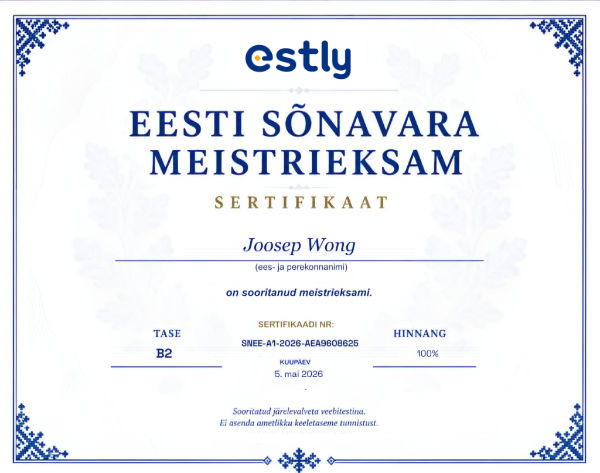
Learners who complete vocabulary levels on Estly.ee can receive a Estly.ee completion certificate — a record of progress inside the platform. This is not an official state language certificate.
Estly.ee supports multilingual learning between Estonian and several languages. Foreigners can use it to learn Estonian, while Estonian speakers can use it to learn other languages through Estonian.
If you are searching for a free Estonian dictionary, an Estonian vocabulary trainer, an Estonian case search tool, or a multilingual Estonian learning platform, Estly.ee was built for you.
From blueblackwhite.com to Estly.ee, this project has been shaped by many quiet contributions. We are especially grateful to Julianna Wong and Lennart Wong for their ideas, feedback, testing, patience, and support.
We are grateful for the scholarship and language resources that form part of the foundation beneath this work.
We are grateful for learning materials that have helped many learners take their first serious steps into Estonian.
In particular, we are deeply grateful to Urmela Kr, whose support and encouragement helped make this journey possible for Joosep Wong. She also provided many valuable suggestions along the way, including important input on the naming of the website. Without her contribution, this product would not be what it is today.
We are especially grateful to Mart Kuhi, Joosep Wong's first Estonian language teacher, whose guidance and encouragement helped shape his journey into the Estonian language and culture.